Gelato vs Ice Cream vs Custard vs Froyo: Key Differences
Most people will tell you gelato is just denser, and they’re right, but there’s a reason for it. Gelato’s made with more milk and less cream, so it has less fat. It gets churned slowly, which keeps air out. It’s kept warmer than ice cream too, and that’s why it stays soft. In the US there’s a legal side to it as well, and federal law only covers half of the four desserts on this page. One section, 21 CFR 135.110, sets the rules for ice cream (at least 10% milkfat) and frozen custard (ice cream with at least 1.4% egg yolk solids). Gelato and frozen yogurt don’t show up in 21 CFR Part 135, the frozen dessert rules, at all. There’s no federal recipe for either, and every maker uses its own.
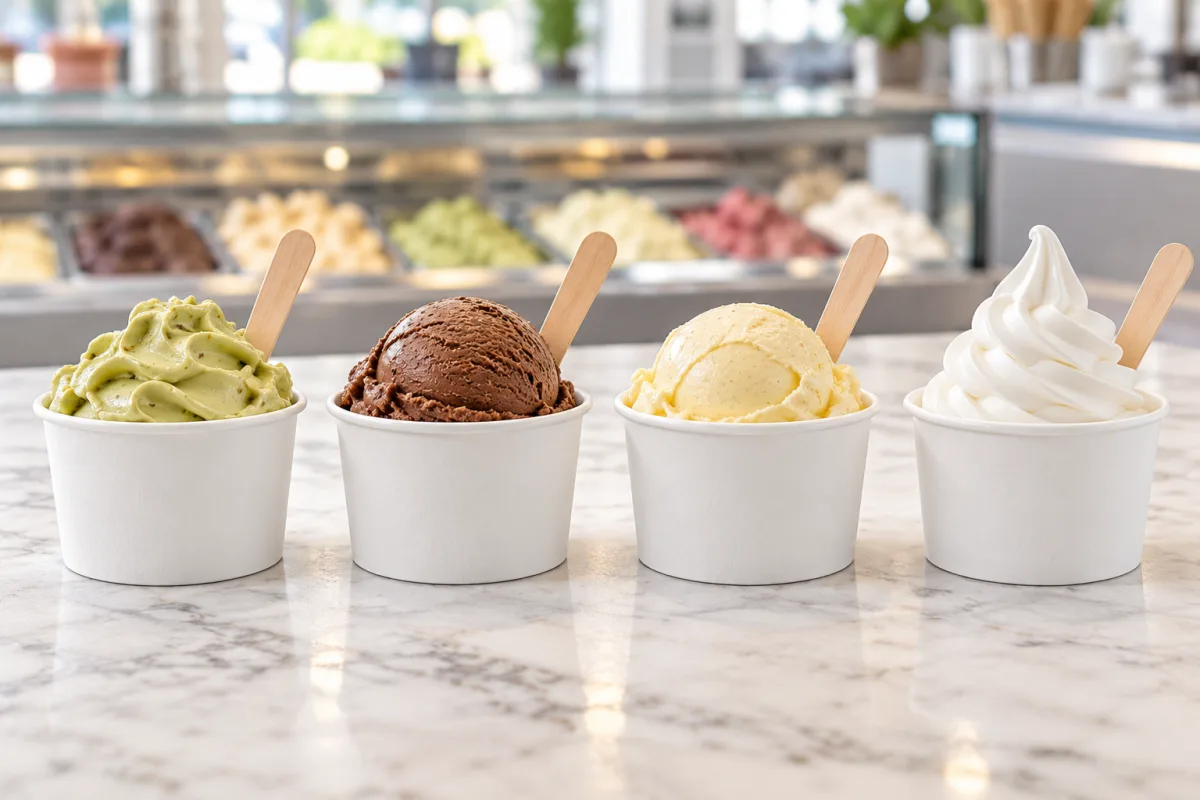
What is the difference between gelato and ice cream?
Gelato’s the denser, softer of the two. The numbers below come from a university food science department, a dairy textbook and a test kitchen, not from gelato shops selling their own product.
More milk, less cream, fewer eggs
We like how Robert Roberts put it back in 2015, when he ran Penn State’s food science department. In a Penn State Q&A he said American ice cream “tends to be made with a lot of cream,” and gelato “is traditionally made with more milk.” Eggs differ too. Most gelato has fewer yolks than ice cream, and some skips them. It even depends where in Italy you are: the Sicilian kind has no eggs and is lighter, and up north they use cream and eggs both, which makes it richer.
Gelato usually has 4 to 8% fat
Gelato typically lands between 4 and 8% fat. That range comes from Goff and Hartel’s Ice Cream, the standard dairy science text, as cited in the UK Food Standards Agency’s ice cream guidance. The same guidance says premium ice cream can go as high as 15 to 20%, and US ice cream can’t go below 10% milkfat by law. FSA adds that gelato tends to be higher in sugar than regular ice cream, though Roberts points out sugar swings a lot from brand to brand in both.
Less air, slower churn
Air makes the biggest difference you can feel. Churning whips it in, and the extra volume it adds is called overrun. Roberts puts dense, low-overrun ice creams at 20 to 40%, Penn State’s own Berkey Creamery ice cream at 50 to 80%, and the fluffiest products at up to 100%, which means double the volume of the mix. Gelato, by his account, has “very little to no air whipped in,” and its machine paddle moves up and down slowly where an ice cream paddle spins fast. America’s Test Kitchen describes the same gap from the ice cream side: American ice cream gets churned until it’s as much as doubled in volume, and that’s where the airy, fluffy texture comes from.
Served warmer and softer
ATK puts gelato’s storage and serving temperature at around 12°F, compared with the 0°F your home freezer runs at. Penn State serves its own ice cream between 0 and 10°F. Warmer means softer, which is why gelato is traditionally scooped from shallow serving trays, as the FSA guidance describes it. Gelato fans often say the flavor comes through stronger with less fat and air in the way. Roberts calls that a matter of taste.
What US federal rules say about gelato and ice cream
Only ice cream has a federal minimum recipe. Gelato has none, so everything above about gelato is what’s typical, not what’s required.
What US rules say ice cream is
The federal rule reads like a recipe card. Ice cream is “a food produced by freezing, while stirring, a pasteurized mix” of dairy ingredients, and 21 CFR 135.110 puts four floors under it:
| Rule | Minimum |
|---|---|
| Milkfat | 10% |
| Nonfat milk solids | 10% |
| Total solids | 1.6 lb per gallon |
| Weight of the finished food | 4.5 lb per gallon |
You won’t find an air limit anywhere in it. It goes by weight instead. A gallon of ice cream can’t weigh less than 4.5 lb.
Gelato has no federal US definition
Gelato has no federal standard of identity. We ran the word “gelato” through a full-text search of Title 21 of the Code of Federal Regulations, the food and drug title, and it came back with zero hits. Part 135, the part for frozen desserts, has six sections: definitions, ice cream and frozen custard, goat’s milk ice cream, mellorine, sherbet, and water ices. Gelato isn’t one of them.
A US shop can sell almost anything as gelato, and the 4 to 8% figure is a typical range, not a floor or a ceiling. One limit on our own check: we looked at federal rules, not at each state’s dairy code.
Custard vs ice cream: the egg yolk line
Frozen custard is ice cream with at least 1.4% egg yolk solids, measured by weight of the finished food. Federal rules don’t split them any other way. They even share a section, 21 CFR 135.110.
There’s one carve-out. Add bulky flavors and the egg yolk number is allowed to drop in proportion to their weight, though never under 1.12%.
To put 1.4% in kitchen terms: a gallon at the 4.5 lb minimum weight carries about 1 oz of egg yolk solids.
Once the egg yolk content goes past the ice cream limit, the name on the carton changes. The rule allows three:
- frozen custard
- french ice cream
- french custard ice cream
Which means a pint labeled “french ice cream” is custard under federal rules, whether or not the word custard shows up anywhere on it. Frozen custard vs ice cream, in the end, comes down to one ingredient and the name it earns.
Frozen yogurt vs ice cream
Ice cream has a federal standard of identity, and frozen yogurt doesn’t. There’s no froyo section in Part 135. Search the full text of Title 21 for “frozen yogurt” and the only place it turns up is the Nutrition Facts reference table at 21 CFR 101.12.
In that table, frozen yogurt shares a line with ice cream and sherbet, and all three get the same reference amount of 2/3 cup. Yogurt itself does have a definition, in 131.200, but there’s no frozen version next to it.
In practice that leaves froyo with no federal milkfat minimum, no culture count and no weight per gallon. Recipes are up to each maker. We’re not getting into calories or health here, since there’s no federal standard to hold froyo up against.
Gelato, ice cream, custard and froyo side by side
Ice cream and frozen custard have a federal definition. Gelato and frozen yogurt have none. Here’s the short version:
| Typical fat | Federal standard | Key federal number | Nutrition Facts reference amount | |
|---|---|---|---|---|
| Ice cream | 10% or more; premium up to 15 to 20% | Yes, 21 CFR 135.110 | 10% milkfat; 4.5 lb per gallon | 2/3 cup |
| Frozen custard | Same 10% floor as ice cream | Yes, 21 CFR 135.110 | 1.4% egg yolk solids (1.12% with bulky flavors) | Not named; 2/3 cup if read as ice cream |
| Gelato | About 4 to 8% | No federal standard | None | Not named |
| Frozen yogurt | Up to each maker | No federal standard | None | 2/3 cup |
| Sherbet, water ices | Not covered here | 21 CFR 135.140, 135.160 | Not covered here | Sherbet: 2/3 cup |
You won’t see the word sorbet in Part 135. Sherbet (135.140) and water ices (135.160) are as close as the federal list gets.
How to read the name on the label
Read the carton name before anything else. “Ice cream” on the front means the maker had to clear the 135.110 minimums, which are 10% milkfat, 10% nonfat milk solids and 4.5 lb to the gallon. Custard under any of its three names clears those same bars and adds at least 1.4% egg yolk solids. “Gelato” and “frozen yogurt” promise nothing federal, and you’d have to turn the carton over and read the ingredients to know what you’re getting.
Which paper cup fits each dessert?
Short answer: 6 or 8 oz for one or two scoops, 12 or 16 oz for a sundae or something to share, and 4 oz for a kid or a taste. That’s how our own size chart splits them. On the label side, FDA works from 2/3 cup for ice cream. It’s the reference amount FDA uses for Nutrition Facts labels, roughly 160 ml (a bit over 5 fl oz), and any coating or wafer counts toward it. The rule says that amount covers “all types bulk and novelties,” cups and cones included. Sundaes have a reference amount of their own, a full cup, about 240 ml.
- Ice cream: 2/3 cup, or 1 cup if it’s a sundae.
- Frozen custard: not in the table by name. We’d read it as ice cream, which makes it 2/3 cup.
- Frozen yogurt: listed right next to ice cream at 2/3 cup.
- Gelato: the labeling table never mentions it.
Heads up on the cup itself: the label cup and your measuring cup aren’t quite the same. Nutrition Facts counts a cup as 240 ml, while a measuring cup is 8 fl oz, or 237 ml.
Here are the five ice cream cup sizes we make:
| Cup | Capacity | Typical use |
|---|---|---|
| 4 oz | 118 ml | Kids’ cup or a sample |
| 6 oz | 177 ml | Single or double scoop |
| 8 oz | 237 ml | Single or double scoop |
| 12 oz | 355 ml | Sundae or sharing |
| 16 oz | 473 ml | Sundae or sharing |
The oz on each cup is the recommended fill, not the brim. Our 12 oz cup holds close to 14 oz when you fill it to the rim. By volume, a 2/3 cup serving comes to about 90% of a 6 oz cup’s rated fill and about 68% of an 8 oz cup’s.
Scoops come down to the disher number. In the USDA Food Buying Guide, a No. 6 disher holds 2/3 cup, a No. 8 holds 1/2 cup, a No. 12 holds 1/3 cup and a No. 16 holds 1/4 cup. Those are level measures, and a rounded scoop off the same disher holds more. You’ll find the full chart, with ml for every size, on our 4 oz to 16 oz ice cream cups page.
We asked our production team whether gelato, froyo, custard and ice cream shops each favor certain sizes. They don’t. Orders come in fairly evenly across the sizes, so pick the cup by portion, not by what’s in it.
Printing your own cups
We print custom ice cream cups in 4, 6, 8, 12 and 16 oz. They’re all single wall, 1,000 to a case in every size, made from paperboard with a PE (polyethylene) lining, and you can get certified compostable board in any of the five. Prices for each size are on the product page.
Questions we get
Does gelato have less fat than ice cream?
Most of the time. Dairy scientists Goff and Hartel put gelato at 4 to 8% fat, and that’s the figure the UK Food Standards Agency goes by. Ice cream sold in the US can’t drop below 10% milkfat, and premium ice cream gets to 15 or 20%.
What does a serving size of ice cream look like?
On a Nutrition Facts label, the serving starts from FDA’s reference amount of 2/3 cup, roughly 160 ml. That’s one level scoop from a No. 6 disher. In our size chart, a single or double scoop goes in a 6 to 8 oz cup.
Is frozen yogurt just soft serve ice cream?
Not as far as federal rules go. Ice cream has its standard in 21 CFR 135.110, and frozen yogurt has nothing like it. In Title 21 it turns up in one place only, the Nutrition Facts table, sitting on the 2/3 cup line next to ice cream.
Is there a legal definition of gelato in the US?
Not a federal one. A full-text search of Title 21 for “gelato” turns up nothing, and Part 135 has no gelato section. We didn’t check state dairy laws.